
.png)


Stop the Ghosting: How 360° Tours Help Couples Remember and Book Your Venue



You have just finished a two-hour site visit. The couple were warm, engaged, and genuinely excited. They asked all the right questions. They stood in the main hall and talked about where the top table would go. They photographed the bridal suite. They told you it was exactly what they had been looking for.
A week passes. No response to your follow-up email. Two weeks. Still nothing. Two months later, you see their wedding photographs on Instagram. They are at a competitor's venue.
If you run a wedding venue, this is not an occasional frustration. It is a structural feature of the market. Industry data consistently shows conversion rates of 20 to 30% for wedding venue viewings, which means that for every ten couples who visit your venue, seven or eight will book somewhere else. Not because your venue was not good enough. Not because the viewing went badly. But because, by the time they made their decision, they had forgotten how good it was.
That is the problem this blog is about. And it is one that 360° virtual tours are uniquely positioned to solve.
Why Couples Ghost After Great Viewings
To understand why ghosting happens, you need to understand what the wedding venue search actually looks like from the couple's perspective.
The average couple visits between five and eight venues before making a decision. Each visit takes two to three hours. Each venue is beautiful, professionally presented, and staffed by people who are genuinely trying to help them imagine their wedding there. Each venue has a unique selling point, a stunning garden, a historic ballroom, a contemporary industrial space, a private estate, and each venue's team communicates that selling point with warmth and conviction.
By the time a couple has completed their fourth or fifth viewing, something predictable has happened to their memory. The details have started to blur. The specific qualities that made each venue distinctive are beginning to merge into a general impression of "nice venues we visited." The emotional high of each individual viewing has faded, replaced by the cognitive challenge of comparing five or six complex, multi-dimensional experiences against each other.
Research on memory decay is unambiguous on this point. Within 72 hours of an experience, people retain approximately 60% of the specific details they absorbed. Within three to four weeks, that figure drops to around 10%. For couples who are simultaneously managing the emotional complexity of planning a wedding, the financial pressure of a significant budget decision, the competing opinions of family members, and the logistical challenge of coordinating two sets of preferences, the cognitive load is already at capacity. Memory decay is not a failure of attention. It is an inevitable consequence of information overload.
The result is a decision-making process that defaults to the path of least resistance. Couples who cannot clearly remember why one venue was better than another will default to the most memorable, the most convenient, or the cheapest. They will choose the venue that followed up most persistently, or the one that a family member visited and endorsed, or the one that happened to have a cancellation at the right price point. They will not necessarily choose the best venue. They will choose the one that stayed most present in their minds.
The Comparison Paradox: Why More Viewings Make Decisions Harder
There is a well-documented psychological phenomenon that makes the wedding venue search particularly challenging for couples: the more options they evaluate, the harder it becomes to choose between them.
This is not simply a matter of having too much information. It is a structural feature of how human decision-making works under conditions of complexity and uncertainty. When every option has genuine merits, when every venue is beautiful and every team is professional and every package is competitive, the rational framework for comparison breaks down. Couples cannot assign a clear numerical value to "the way the light fell in the main hall" or "the feeling of standing on the terrace." These are experiential qualities, and they resist comparison.
The result is decision paralysis. Couples who have visited six venues and cannot clearly differentiate between them will often delay the decision indefinitely, hoping that clarity will emerge, or will make the decision on a proxy criterion, price, availability, or family preference, rather than on the experiential quality that actually matters to them.
There is a further complication that is specific to wedding planning: the decision is rarely made by the couple alone. Parents, siblings, bridesmaids, and close friends all have opinions, and those opinions are often based on second-hand accounts of venues they have never visited. A couple who loved your venue during their viewing may find that enthusiasm eroded by a family member who preferred a different space based on photographs alone, or who raised concerns about logistics or cost that the couple cannot confidently address because their own memory of the details has faded.
What 360° Virtual Tours Do to the Memory Problem
The fundamental insight behind using 360° virtual tours in wedding venue marketing is simple: if couples forget how good your venue is because they cannot revisit the experience, give them a way to revisit it.
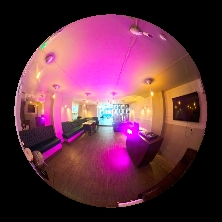
A 360° virtual tour of your venue, produced to a standard that genuinely captures the atmosphere, the scale, the light, and the flow of the space, becomes a permanent, on-demand version of the viewing experience. Couples can return to it at any time, from any device, as many times as they need to, without requiring any involvement from your team.
Revisiting reinforces emotional connection.
Every time a couple returns to your virtual tour, they re-experience the qualities that made them excited during the viewing. The emotional connection that began in person is reinforced and deepened rather than allowed to fade. The venue that offers this experience stays present in the couple's minds throughout the decision-making process in a way that venues relying on static photography and follow-up emails simply cannot match.
Shared exploration removes the second-hand problem.
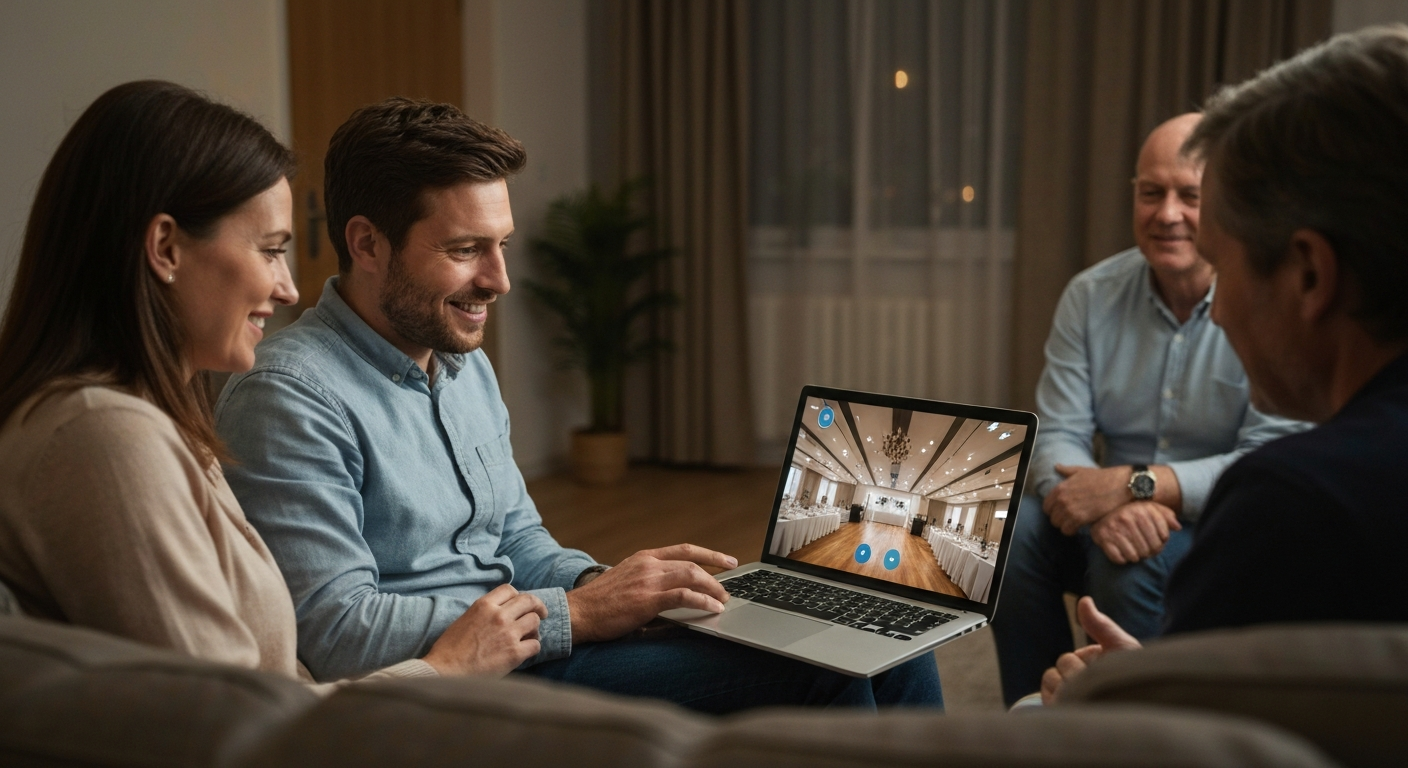
When a couple can share a link to your virtual tour with parents, siblings, and friends, those family members are no longer forming opinions based on second-hand descriptions or flat photographs. They are experiencing the venue themselves, exploring the spaces, understanding the flow, and forming their own emotional connection to the space. The family member who might otherwise have raised objections based on incomplete information becomes an advocate who has experienced the venue directly.
Side-by-side comparison favours the venue that can be experienced.
When couples are comparing venues in the final stages of their decision, the venues that can be revisited and explored in depth have a structural advantage over those that exist only as memories and photographs. A couple who can pull up your virtual tour and walk through the main hall one more time, while simultaneously looking at a competitor's static gallery, is not making an equal comparison. They are comparing an experience against an image. Experience wins.
Embedded information answers questions without requiring a follow-up call.
A well-produced 360° virtual tour can incorporate images, video, audio, and information hotspots that allow couples to explore not just the physical space but the details of what your venue offers. Catering options, capacity configurations, ceremony and reception layouts, accommodation, parking, and accessibility information can all be embedded directly into the tour, allowing couples to answer their own questions at their own pace. Every question answered independently is a question that does not create friction in the decision-making process.
The Commercial Impact: What Changes When Couples Can Revisit
The revenue impact of solving the memory problem is measurable and significant.
Wedding venues using 360° virtual tours as a core part of their post-viewing follow-up process consistently report conversion rate improvements from the industry average of 20 to 30% to 50 to 60% or above. The improvement is most pronounced in the premium segment, where the decision is most emotionally complex and the stakes of getting it wrong are highest.
The time from viewing to booking decision shortens significantly. Couples who have access to a virtual tour they can revisit and share typically make their decision in two to three weeks rather than the six to eight weeks that is standard in the industry without immersive tools. Shorter decision cycles mean less time spent on follow-up, less pipeline congestion, and more revenue recognised earlier in the financial year.
Unqualified viewings, the site visits that consume two to three hours of your team's time and result in no booking, reduce substantially when couples have already explored your venue in depth before arriving. Couples who have spent time with your virtual tour before their viewing arrive already informed, already emotionally invested, and already further along in the decision-making process. The viewing becomes a confirmation rather than an introduction, and the conversion rate on those visits is dramatically higher.
Destination and international bookings, which have historically been difficult to convert without an in-person visit, become significantly more accessible. Couples planning a destination wedding who can experience your venue in full detail from anywhere in the world are far more likely to commit to a booking without requiring a preliminary visit. This opens a segment of the market that most venues are currently invisible to.
The Bottom Line: Couples Book the Venue They Remember Best
The wedding venue market is not won by the venues with the most beautiful spaces. It is won by the venues that stay most present in couples' minds throughout a long, complex, emotionally charged decision-making process.
360° virtual tours solve the memory problem that causes ghosting. They give couples a way to revisit the experience of your venue, share it with the people whose opinions matter, compare it accurately against alternatives, and build the confidence they need to commit. Every revisit reinforces the emotional connection that began during the viewing. Every shared exploration turns a family member's second-hand opinion into a first-hand experience. Every question answered independently removes a barrier to booking.
The venues thriving in 2026 are not the ones with the biggest marketing budgets. They are the ones making it effortless for couples to remember why they fell in love with the space, and to say yes with confidence.
Ready to Turn More Viewings into Bookings?
At Revol Studios, we create immersive 360° virtual tours that help couples remember your venue, share it with family, and book with confidence, transforming industry-standard conversion rates of 20 to 30% into 50 to 60% and above.
Our wedding venue clients are currently:
- Reducing wasted viewings by up to 60%, with couples arriving pre-qualified and emotionally invested
- Accelerating booking decisions from 6 to 8 weeks to 2 to 3 weeks, improving pipeline velocity and cash flow
- Converting destination and international enquiries from couples who cannot visit in person before committing
- Increasing average booking values by giving couples the confidence to choose on quality rather than defaulting to price
Your venue is not losing bookings because it is not good enough. It is losing them because couples forget how good it is. Give them a reason to remember.
Click here to book a discovery call and find out how Revol Studios can transform your viewing-to-booking conversion rate.
More Blogs



Let’s Build Something
.jpg)
Tell us your goals, and we’ll help you design the perfect creative solution.