
.png)


Turn Insight into Impact: How Analytics Drive Continuous Business Improvement




Most business decisions are still made on instinct. A campaign feels like it is working. A product page seems to be converting well. A particular service appears to be attracting the right clients. The language of business is full of approximations, and for a long time, approximation was the best available tool.
That is no longer true. In 2026, the data needed to replace instinct with evidence is available to every business, regardless of size, sector, or budget. The businesses pulling ahead of their competitors are not doing so because they have better instincts. They are doing so because they have replaced instinct with insight, and they are acting on that insight faster and more precisely than the businesses still operating on gut feel.
Analytics is not a technology story. It is a decision-making story. And the decisions it enables, about where to invest, what to fix, what to stop doing, and what to double down on, are the decisions that compound into meaningful, measurable growth.
Why Gut Instinct Is No Longer Enough
There is nothing wrong with experience-based judgement. Seasoned business owners and marketers develop genuine pattern recognition over time, and that pattern recognition has real value. The problem is not that instinct is unreliable. The problem is that instinct alone cannot keep pace with the complexity and speed of modern markets.
A campaign that worked brilliantly eighteen months ago may be underperforming today, not because the strategy was wrong, but because audience behaviour has shifted, a competitor has entered the market, or a platform algorithm has changed. Without data, you will not know this until the underperformance has already cost you significant revenue. With data, you will know within days, and you will be able to respond before the damage compounds.
The same principle applies across every dimension of business performance. A product page that is attracting traffic but not converting is a problem that instinct might attribute to pricing, messaging, or audience quality. Analytics will tell you exactly where users are dropping off, what they are doing before they leave, and what the pages that do convert have in common. The difference between guessing and knowing is the difference between iterating randomly and improving with intent.
Beyond Vanity Metrics: What Analytics Actually Tells You
One of the most common mistakes businesses make when they begin engaging with analytics is focusing on the wrong numbers. Vanity metrics, page views, social media followers, email open rates, are easy to track and satisfying to report. They tell you that people noticed you. They do not tell you that people acted.
The metrics that drive business improvement are performance metrics: conversion rates, revenue per visitor, cost per acquisition, customer lifetime value, churn rate, and the specific points in your funnel where potential customers are dropping out of the journey. These numbers are less immediately gratifying than follower counts, but they are the ones that connect directly to revenue, and they are the ones that tell you where to focus your attention.
Conversion rate tells you what proportion of the people who engage with your marketing, visit your website, or enter your sales process actually take the action you want them to take. A conversion rate of 2% on a landing page that is receiving 10,000 visitors per month means 200 conversions. Improving that rate to 3% through data-informed optimisation means 300 conversions from the same traffic, a 50% increase in output with no increase in marketing spend.
Drop-off points tell you where in the customer journey people are abandoning the process. A high drop-off rate on a specific page, at a specific stage of a booking flow, or at a particular point in a sales conversation is a signal that something is creating friction. Analytics identifies the signal. Your team investigates the cause and tests a solution. The result is a funnel that improves continuously rather than remaining static.
Campaign ROI tells you which of your marketing investments are generating returns and which are consuming budget without producing results. In a world where marketing budgets are finite and the pressure to demonstrate return on investment is constant, the ability to allocate spend to what works and cut what does not is a significant competitive advantage.
Where Analytics Makes the Biggest Difference
The impact of analytics is not confined to marketing. When data is connected across the different functions of a business, the compounding effect on performance is substantial.
Website & Digital Performance
Analytics tools reveal which pages on your website are driving conversions and which are losing visitors. They show you how people are finding you, what they are doing when they arrive, and where they are leaving. This information allows you to optimise the pages that matter most, improve the content that is underperforming, and invest in the channels that are delivering the highest quality traffic.
Sales & Marketing Alignment
One of the most persistent inefficiencies in business is the gap between marketing and sales, where marketing generates leads that sales cannot convert, or sales identifies objections that marketing is not addressing. Analytics bridges this gap by making the full customer journey visible. Marketing can see which campaigns are generating leads that actually convert. Sales can see which content prospects have engaged with before entering the pipeline. The result is a more coherent, more effective revenue operation.
Customer Experience & Retention
Analytics applied to customer behaviour after the sale, support ticket volumes, satisfaction scores, repeat purchase rates, and churn patterns, reveals the specific points in the customer experience where expectations are not being met. Businesses that monitor these signals and act on them consistently outperform those that rely on periodic surveys and anecdotal feedback. The difference between a customer who churns and one who renews is often a single unresolved friction point that data would have identified weeks earlier.
Operational Efficiency
Analytics is not only a commercial tool. Applied to operations, it reveals patterns in demand, resource utilisation, and process performance that allow businesses to reduce waste, anticipate pressure points, and allocate resources more effectively. A venue that can predict peak enquiry periods from historical data can staff accordingly. A service business that can identify which client types generate the highest lifetime value can focus its business development effort more precisely.

The Compounding Effect: Why Continuous Improvement Beats One-Off Optimisation
The most important thing to understand about analytics-driven improvement is that its value is not in any single insight. It is in the compounding effect of continuous, incremental improvement over time.
A business that improves its conversion rate by 5% in one quarter, reduces its cost per acquisition by 8% in the next, and increases its customer retention rate by 10% in the quarter after that has not made three modest improvements. It has fundamentally changed its unit economics. The same marketing spend is generating more leads. Those leads are converting at a higher rate. The customers they produce are staying longer and spending more. The cumulative impact on revenue and profitability is transformational.
This is why the businesses that invest in analytics infrastructure early, and build the habit of acting on data rather than simply collecting it, tend to pull away from competitors over time. The gap between a data-driven business and one still operating on instinct does not close. It widens.
Getting Started: Making Analytics Work in Practice
The barrier to analytics-driven improvement is rarely technical. The tools are accessible, affordable, and increasingly intuitive. The barrier is almost always organisational: knowing which metrics to focus on, building the habit of regular review, and creating a culture where data informs decisions rather than simply validating them.
Start With The Metrics That Connect Directly To Revenue
Resist the temptation to track everything. Identify the three to five numbers that most directly reflect the health of your business, conversion rate, revenue per customer, retention rate, cost per acquisition, and build your reporting around those. Everything else is context.
Automate Your Reporting
Manual data collection is time-consuming and inconsistent. Set up dashboards that surface your key metrics automatically, and configure alerts that notify you when something significant changes. The goal is to spend your time acting on insights, not gathering them.
Build A Regular Review Rhythm
Data without a review process is just noise. Schedule a weekly or fortnightly review of your key metrics, with a standing agenda item for identifying what has changed, why it has changed, and what you are going to do about it. Make this a team habit, not an individual responsibility.
Test, Learn, & Iterate
Analytics tells you what is happening. It does not always tell you why. Build a culture of structured experimentation, where hypotheses are tested, results are measured, and learnings are applied to the next iteration. The businesses that improve fastest are not the ones with the most data. They are the ones that act on it most consistently.
Share The Wins
Analytics makes the impact of good decisions visible. When a campaign optimisation drives a measurable improvement in conversion rate, or a customer experience change reduces churn, make that result visible to the team. Data-driven wins build confidence in the process and reinforce the habit of evidence-based decision-making.

The Bottom Line: Insight Without Action Is Just Information
The value of analytics is not in the numbers themselves. It is in the decisions they enable and the improvements they drive. Businesses that measure what matters, act on what they find, and build the habit of continuous improvement consistently outperform those that rely on instinct, experience, and periodic reviews.
In 2026, the competitive advantage belongs to the businesses that know what is working, fix what is not, and improve faster than anyone else. Analytics is the infrastructure that makes that possible.
The question is not whether your business should be data-driven. The question is how much longer you can afford not to be.
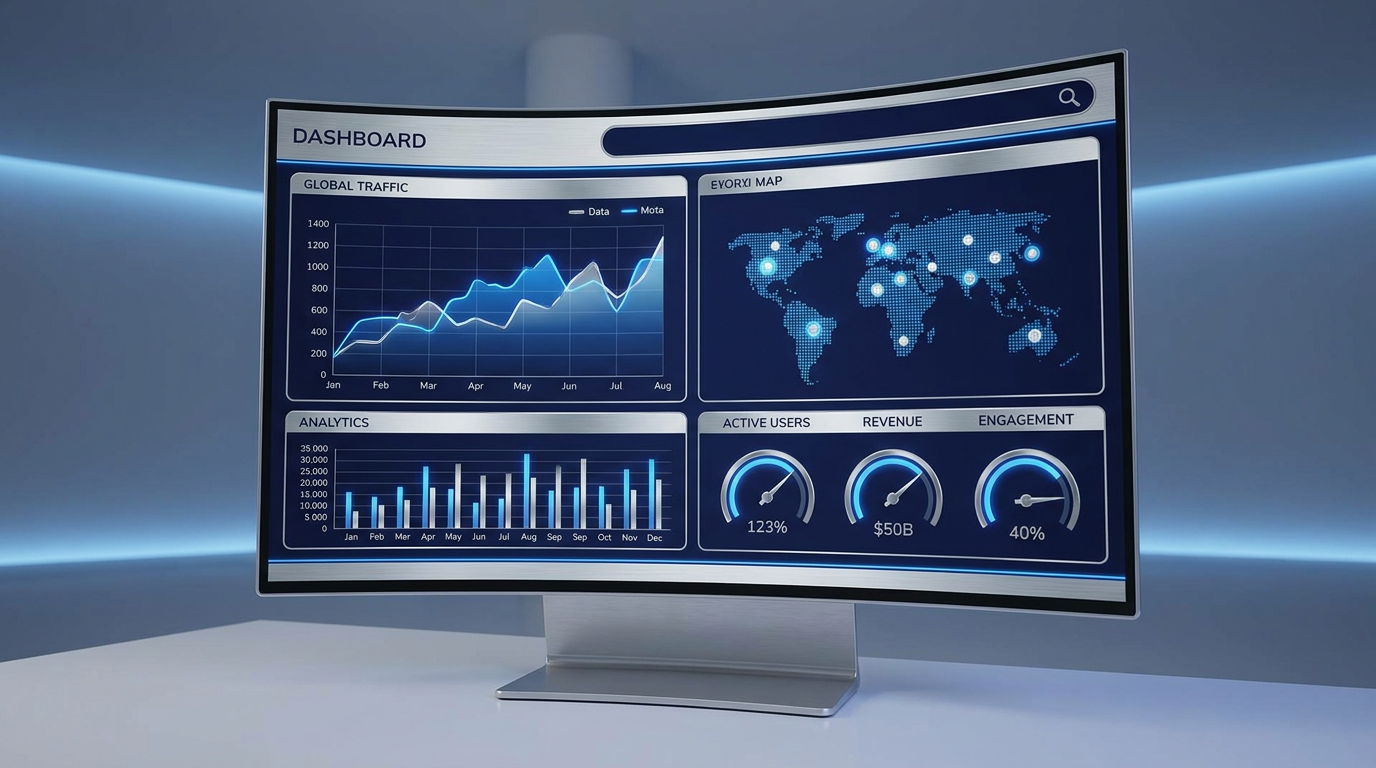

Ready to Turn Insight into Impact?
At Revol Studios, we help businesses set up, interpret, and act on analytics, so every campaign, product, and service gets better, faster, and more profitable.
Our clients are currently:
- Improving conversion rates by 20 to 40% through data-informed optimisation of their key customer journeys
- Reducing wasted marketing spend by identifying and cutting underperforming channels in real time
- Shortening sales cycles by understanding exactly where prospects are dropping out and removing the friction
- Building continuous improvement habits that compound into measurable revenue growth quarter on quarter
Stop guessing. Start knowing. The data is already there. You just need to use it.
Click here to book a discovery call and find out how Revol Studios can help you turn your analytics into a competitive advantage.
More Blogs



Let’s Build Something

.jpg)
Tell us your goals, and we’ll help you design the perfect creative solution.